

General
Each year, the AGEM research institute organizes a seminar series focused on metabolism: the Tager Lectures. These lectures are named after Professor Joseph Tager, who made important contributions to Fabry, Pompe and Gaucher disease and had a major impact on our understanding of peroxisomal diseases. He was chairman of the Biochemistry Department at the University of Amsterdam (1980-1991).
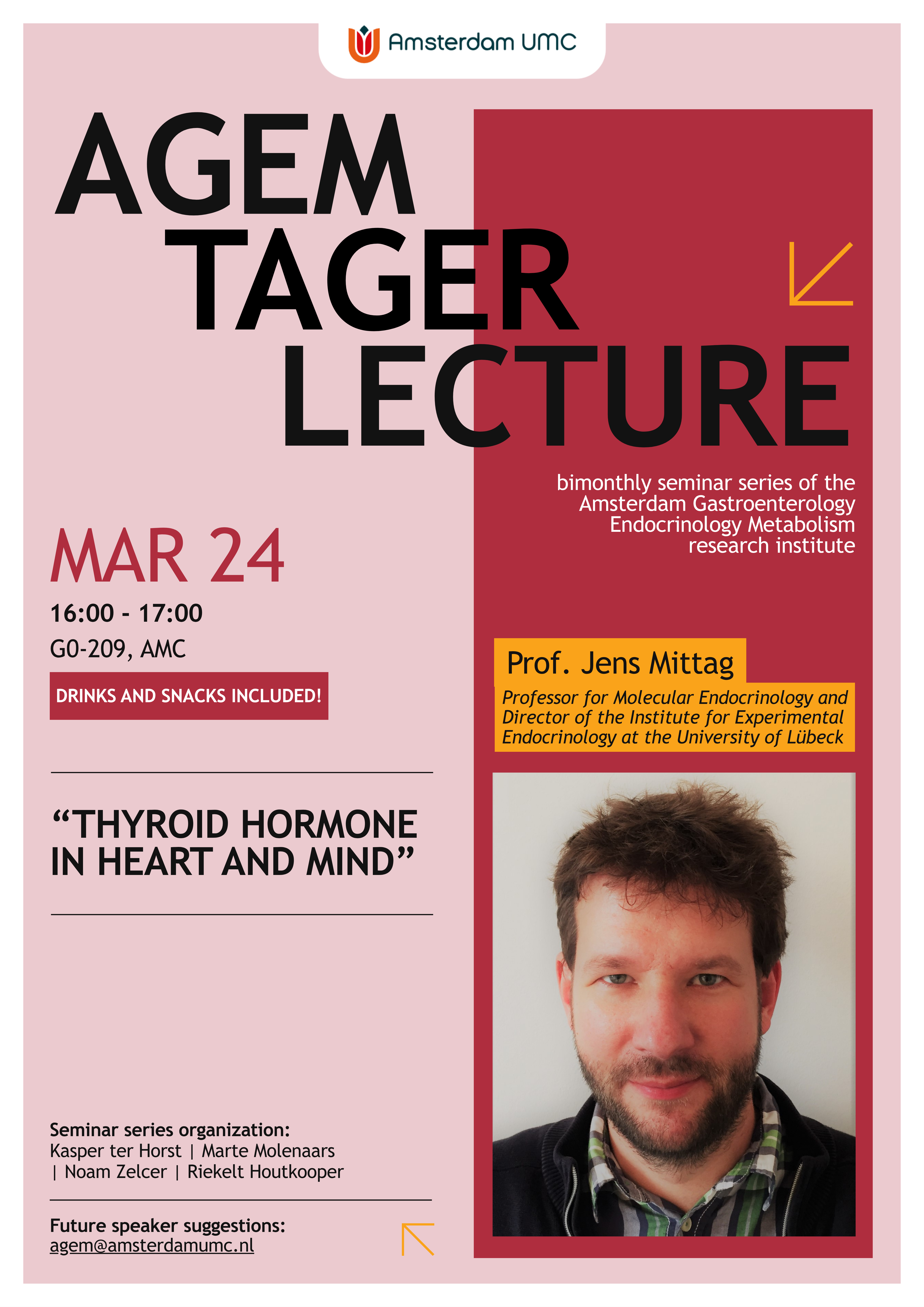
On Wednesday March 24th 2027, the Tager seminar series will continue with a new lecture by Jens Mittag.
Jens Mittag is Professor for Molecular Endocrinology and Director of the Institute for Experimental Endocrinology at the University of Lübeck, Germany. He earned his Diploma in Biochemistry from the University of Hannover in 2003, and his PhD in Endocrinology from the Max Planck Institute for Experimental Endocrinology and the University of Hannover in 2006. He was subsequently a postdoc with Björn Vennström at the Karolinska Institute in Stockholm, Sweden, where he then became Assistant and Associate Professor funded by the Swedish Research Council. He returned to Germany in 2014 with a DFG funded Heisenberg Professorship. His work focuses on the role of thyroid hormone in the control of heart rate, body temperature and metabolism.
Thyroid hormone in heart and mind.
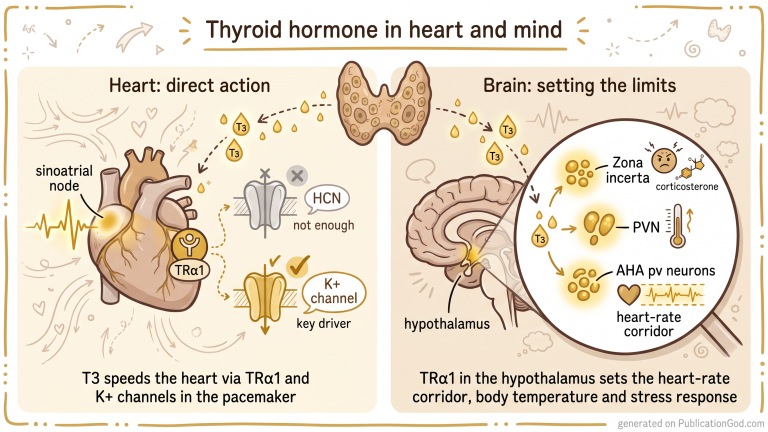
Thyroid hormone is known as the body’s metabolic accelerator, but it also strongly affects the heart and the brain. The lecture shows thyroid hormone controls heart rate and brain functions, and how these to interact to control heart rate: First, it acts directly on the heart. It works through thyroid hormone receptor TRα1 in the heart’s pacemaker. The textbook credits a family of pacemaker channels called HCN channels for the higher heart rate, but our data show that this is in fact not the case. In contrast, potassium channels turn out to be the key players, although the search for the candidates is still ongoing. Secondly, the hormone works through the brain. A small group of neurons in the anterior hypothalamus needs thyroid hormone to develop properly. Depending on the thyroid hormone level, these neurons set the permitted heart rate range, defining the allowed upper and lower limits. Neighbouring brain regions use thyroid hormone to regulate body temperature and the stress response.
Date and Location
Snacks and drinks included!