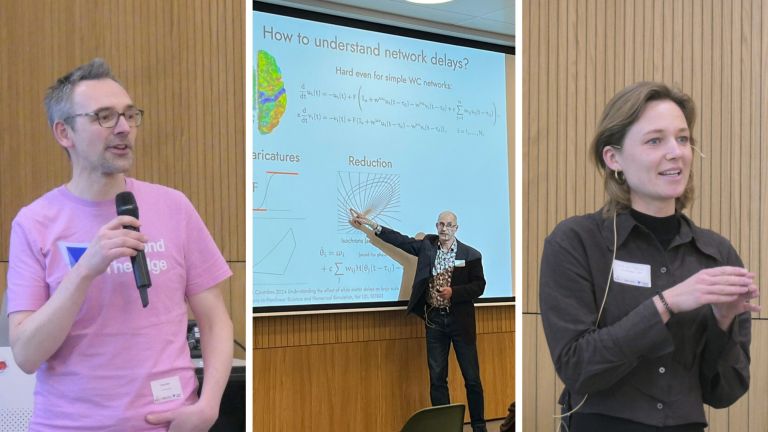
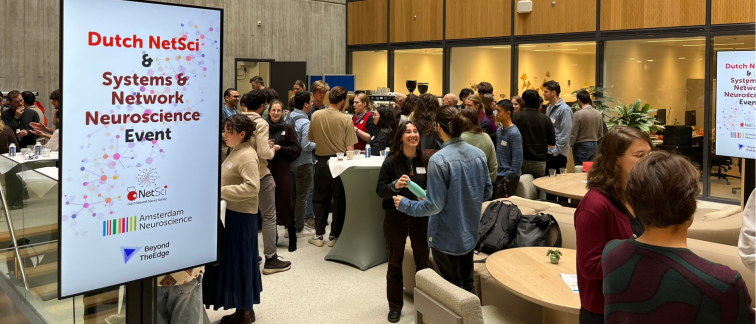
The afternoon started with the network-focussed presentations by Nelly Litvak (TU/Eindhoven) and Maxime Lucas (Namur/Louvain). This was followed by short talks from junior researchers and a presentation by the winner of the NetSci NL Young Talent Prize Alberto Ceria.
After the break, the focus shifted to the translation of network science into neuroscience. Stephen Coombes, Professor of Applied Mathematics in the School of Mathematical Sciences at the University of Nottingham and member of the Brain and Body Centre, presented on understanding the effects of communication delays shaped by white matter on large-scale brain dynamics. His team approaches this topic from the perspective of neural mass and network modeling and is developing a new set of mathematical tools to unravel the contributions of axonal delays to large-scale spatiotemporal patterns of brain activity. Their goal is to better understand how network delays shape brain dynamics. While a direct translation of these mathematical models into clinical practice is challenging—it requires, for example, to bridge data at microscopic scales with macroscopic brain dynamics—such models provide valuable qualitative insights into node dynamics and large-scale network behavior.
Anne van Nifterick, postdoctoral researcher at the Alzheimer Center Amsterdam, continued with a presentation on hyperexcitability in Alzheimer’s disease. Her research addresses several challenges, including the early detection of the disease. She focuses on developing robust, non-invasive measures that are sensitive to subtle imbalances between excitation and inhibition. Another key aim is translating research findings into clinical relevance by identifying the cellular and molecular mechanisms underlying excitation/inhibition imbalance in individuals with Alzheimer’s disease. Ultimately, Van Nifterick seeks to highlight the importance of making subtle excitation/inhibition changes measurable at the network level, with the long-term goal of identifying potential network-based therapeutic strategies for treating Alzheimer’s disease in its earliest stages.