
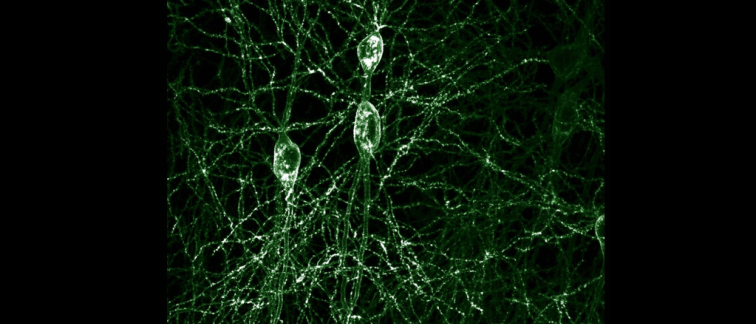
Researchers Angela Getz and Maxime Malivert, from the Functional Genomics Lab at the CNCR, and their colleagues in France, Canada, and the U.K. discovered the new insights, as published in Neuron. These results open up new avenues of research.
Using new molecular tagging and advanced imaging approaches, the researchers visualised the molecules that transmit signals at the receiving side of the synapse. This approach allowed them to track these receptors in real time in intact brain tissue and follow their movements across the surface of synapses. The same approach also allowed them to manipulate the mobility of these molecules and ask how their mobility contributes to information processing.
Synapses have their own built-in gain control
The researchers observed that this mobility plays a crucial role when synapses are activated at high frequencies. Under normal conditions, the receptors temporarily desensitise after repeated activation. Their mobility allows new receptors to move into the synapse and replace those that have become desensitised, thus maintaining strong signal transmission. When their mobility is blocked, desensitised receptors remain trapped in the synapse and transmission decreases sharply, acting as a brake.
This mechanism therefore acts as a gain control; an acceleration or deceleration system integrated into each synapse. Remarkably, not all synapses rely on this principle in the same way. Depending on their architecture and molecular properties, some are very sensitive to receptor mobility, while others are much less so. Each synapse thus possesses its own “dynamic signature” of information processing.
Receptor mobility opens new paths for brain research
The researchers also show that when the brain stores new information, it does so by modifying this receptor mobility. These results open up new avenues of research: many physiological or pathological factors – stress, aging, neurodegenerative diseases – may be influenced by modulating receptor mobility.
Assistant Professor Angela Getz, postdoctoral researcher Maxime Malivert, and their team have established these advanced imaging setups and techniques in the VU Research Building. They currently investigate how architecture and molecular properties of different synapses determine their “dynamic signature”. They also train master students to operate the setup and visualize individual molecules in intact brain tissue in real time.
Read the publication in Neuron: Synapse-specific and plasticity-regulated AMPA receptor mobility tunes synaptic integration