

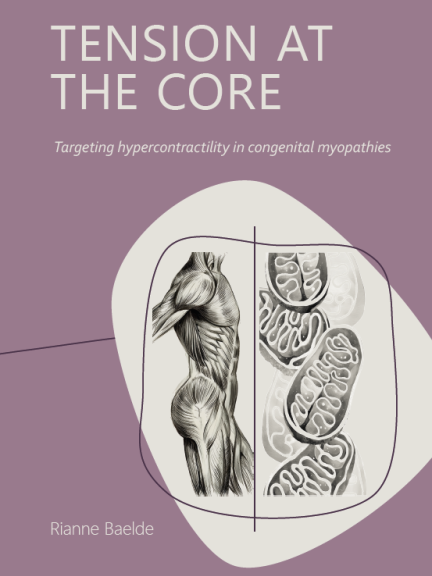
ACS proudly announces the PhD thesis of Rianne Baelde, "Tension At the Core: Targeting hypercontractility in congenital myopathies." Her work sheds light on how nemaline myopathy type 6 (NEM6) starts and progresses over time, and shows that several treatment strategies can counteract the disease, from gene therapy to a readily available supplement.
An unmet need
NEM6 is a congenital muscle disease caused by variants in the KBTBD13 gene. Most patients carry the same Dutch founder variant. Patients experience progressive muscle weakness and muscle stiffness, because their muscles relax too slowly. In addition, the mitochondria, the energy factories of the muscle cells, function less well. For NEM6, as for most congenital myopathies, no treatment is currently available. Moreover, little is known about the onset and progression of the disease. "Patients are usually only diagnosed when the symptoms are already there," Baelde explains. "We knew very little about how the disease starts and progresses. That is where we wanted to start."
A unique mouse model
To study the disease course, Baelde used a NEM6 mouse model that copies most of the symptoms observed in NEM6 patients, which is quite unique. A study of the disease course showed that NEM6 mice are born healthy. Abnormalities in muscle and mitochondrial function only became visible at three months of age, and progressively increased up to nine months. Based on this study, she determined the right time windows to test treatments, both before and after the symptoms appear. "The mouse model allowed us to study how the disease starts and progresses," Baelde says. "And that told us when to intervene."
Reversing the disease
A first strategy was gene therapy, in which a single injection silences the Kbtbd13 gene. "A single injection was enough to restore muscle function and structure in the mice," Baelde notes. "That is a very important finding, showing that the disease symptoms can be reversed, which we did not know until now. However, translating these results to patients is complex and challenging and takes time. That is why we also looked at options that could reach patients sooner."
Repurposing existing drugs
Baelde therefore tested whether existing drugs could slow down disease progression. Nicotinamide riboside, a form of vitamin B3, improved mitochondrial respiration and prevented damage to the mitochondria. As it is readily available as a supplement, this is a promising treatment strategy for NEM6 patients. In addition, she tested a long-term preventive treatment with a myosin inhibitor, a drug that specifically reduces the contraction of skeletal muscles and lowers the energy demand of the muscle cells. This improved mitochondrial respiration and reduced the core formation in the muscles. "The muscles of NEM6 patients are hypercontractile, which puts a high workload on the mitochondria," Baelde explains. "By lowering that workload, or by supporting the mitochondria with vitamin B3, we could improve muscle metabolism in the mice. And these strategies may also apply to patients with other congenital myopathies with similar symptoms."
The heart in NEM6
Part of the NEM6 patients also develop heart problems. Baelde shows that heart muscle cells of NEM6 mice contract and relax too slowly, which affects cardiac function in the body. She found increased levels of detyrosinated α-tubulin, a mechanism that can contribute to these impairments. Acute treatment with mavacamten and EpoY, two substances known to accelerate contraction and relaxation in heart muscle cells, also proved effective in NEM6 heart muscle cells. "In heart muscle cells of NEM6 mice, contraction and relaxation were slowed down," Baelde concludes. "Two substances that accelerate this also worked in the NEM6 cells. That is a promising starting point to counteract the cardiac involvement in NEM6."
PhD defense
The public defense of Rianne Baelde will take place on 30 November 2026, 09:45h at the VU Auditorium. The ceremony can also be followed online via livestream. For more information, see the VU website.