

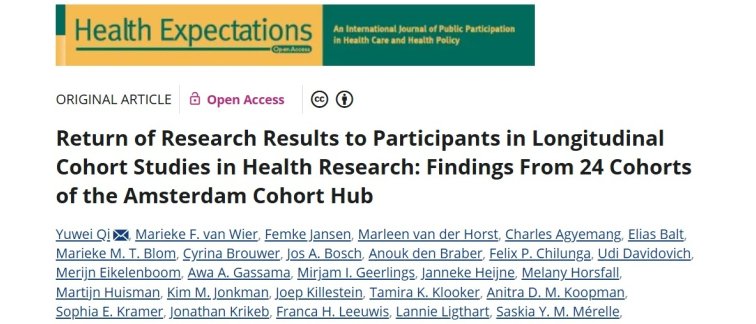
The paper, Return of research results to participants in longitudinal cohort studies in health research: Findings from 24 cohorts of the Amsterdam Cohort Hub, explores how cohort studies communicate research results back to the people who contribute their data.
How do cohorts return research results?
Returning research results is increasingly seen as an important part of participant-centred research. Yet there is still limited knowledge about how longitudinal cohort studies organize this in practice.
The researchers therefore mapped practices across 24 population- and patient-based cohorts within ACH. They examined what results are returned, when they are communicated and how they are shared, as well as the motivations and challenges cohorts encounter.
The study shows that returning results is already widely practiced. Group-level findings, for example through newsletters and other accessible communication channels, are shared by almost all cohorts. Returning individual results is more selective and often focuses on laboratory or clinical measures that can be interpreted relatively easily.
At the same time, practices differ considerably between cohorts. Concerns about how participants may interpret results, as well as limited time, funding and capacity, are important barriers.
The findings point to opportunities for shared guidance, communication tools and sustainable infrastructure to help cohorts return research results responsibly and consistently.

Open science in practice
The topic is central to open science. Cohort participants contribute data over many years, and whether they hear what comes of it shapes how accountable research is to the people who make it possible. For cohort studies this had not been documented before. Moreover, the paper is open science in practice. It is published open access, the structured questionnaire developed for the study is included as an appendix, and the collected information is available on request. Any cohort or network can use the questionnaire to review its own practice.
A milestone for ACH
The publication is not only relevant for participant communication, but also marks an important step in the development of ACH.
ACH connects longitudinal cohort studies to share knowledge, expertise and infrastructure and to create opportunities for collaboration across individual cohorts. This study shows that collaboration in practice: experiences from 24 different cohorts were brought together to address a question that is relevant to cohort research as a whole.
It is the first scientific publication to emerge from collaboration within ACH, a good example of how connecting cohorts can generate new knowledge that benefits the wider cohort research community.