
Large-scale testing of new and existing medications
Kim de Kleijn – Amsterdam UMC – CANDIDATE Center
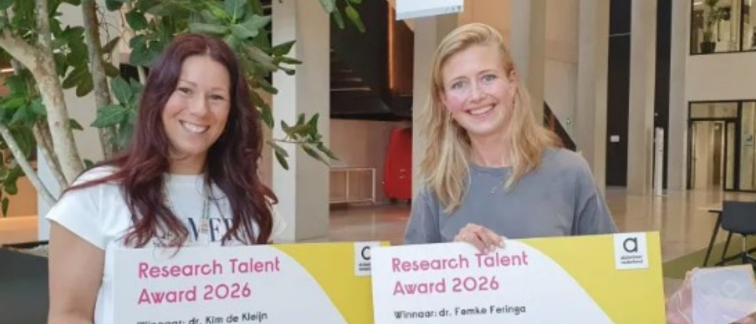
“I’m proud to have received this award,” says Kim de Kleijn. “It feels like recognition of my passion and dedication to this research.” De Kleijn studies microglia in the brain. In dementia, a subset of these cells does not function properly. She converts skin cells into stem cells and then into microglia, allowing her to closely investigate what goes wrong and when it happens.
De Kleijn plans to use the award funding to better understand the complexity of the disease and contribute to the development of potential treatments for dementia. Specifically, the award will support her efforts to establish a microglia drug-screening pipeline within the CANDIDATE Center and to investigate how different microglial subtypes contribute to Alzheimer’s disease and when they should be targeted.
Learning from cancer research
Femke Feringa – Vrije Universiteit Amsterdam
Femke Feringa is also delighted to have received the award. “Now I can start my own line of research. Without this award, that would have been very difficult.” In her research, Feringa compares cancer cells with brain cells affected by dementia. Cells can enter a kind of hibernation-like state. “This has a protective effect against cancer because it prevents cells from dividing and forming tumors,” she explains. “But this process may actually contribute to the development of dementia. In dementia, there are fewer and fewer cells over time.”
Feringa aims to better understand the role this “hibernation” process plays in dementia. It has not yet been studied in the context of dementia. She is pursuing this research using stem cell models, and the award funding will help support that work. Ultimately, she hopes to identify new leads for treatments. “I’m very curious to see what we’ll discover by exploring this new path.”
Source: Alzheimer Nederland