

Imagine an Amsterdam where a biomarker discovered in one lab on Monday runs on another lab’s cohorts by Friday, feeding into a clinical report the following week. Where PhD students leave behind not just folders of scripts, but methods that other groups actively use. Where data is organized, accessible, and interoperable, adding value to future studies instead of being lost on local drives. Where asking how an analytical idea performs on ENIGMA data takes an afternoon rather than a year. Where Amsterdam becomes the primary hub international consortia turn to for rigorous, large-scale EEG analysis. This is what a cumulative EEG ecosystem enables: research that compounds over time and builds a direct connection between discovery and patient care.
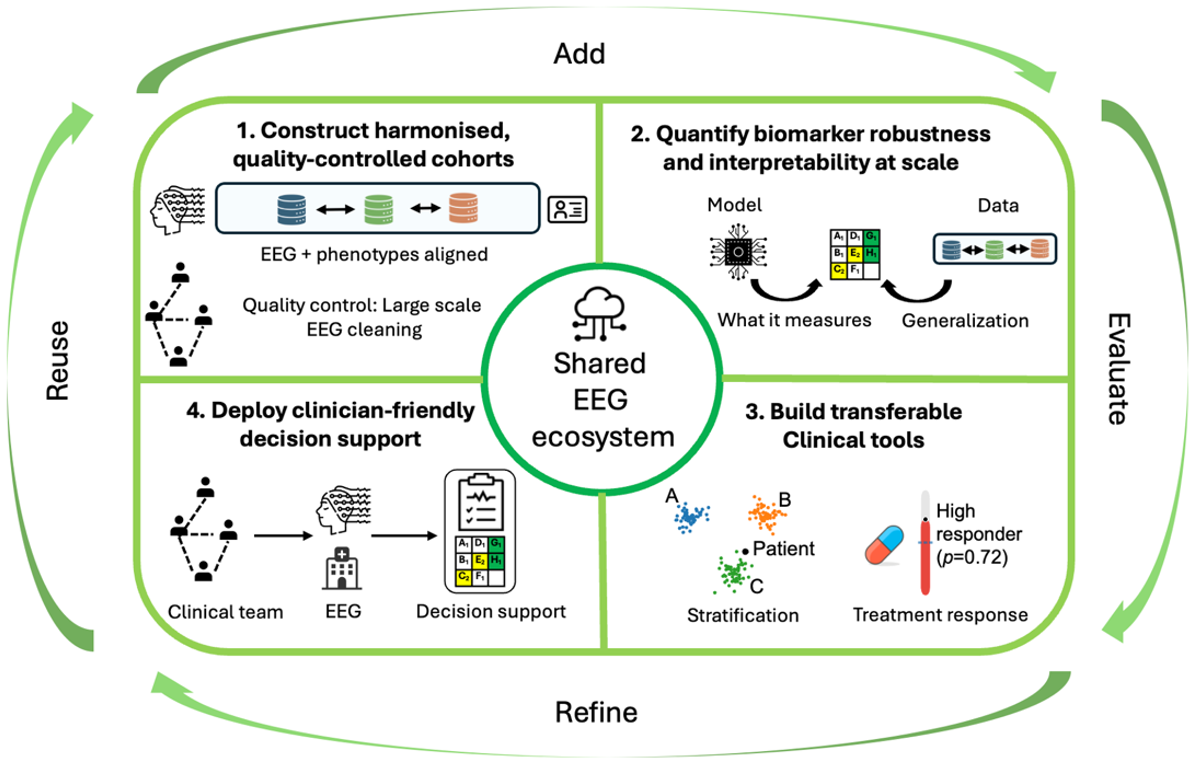
A shared EEG ecosystem enables reusable EEG data, workflows, biomarkers, models, and reports across groups. A prototype is already active at the N=You Center for Neurodevelopmental Disorders at Amsterdam UMC, while the cloud version has supported large-scale student training and EEG cleaning.
Toward a shared EEG ecosystem
EEG is recorded across Amsterdam in growing volumes, and the international community has made vast open datasets available. Yet most analyses still occur in isolated scripts and incompatible formats. While the field has no shortage of promising biomarkers, a framework to make them cumulative has been missing. The team aims to provide Amsterdam Neuroscience with the infrastructure to bridge this gap.
Over the past decade, the developers have been building the Neurophysiological Biomarker Cloud, an EEG platform where data, analyses, biomarkers, and clinical reports reside in a single shared, version-controlled environment. When a feature is added, other users can apply it to their own data with minimal effort. A biomarker that proves effective in research becomes immediately available for clinical use. A prototype is currently running at Amsterdam UMC, supporting the N=You Neurodevelopmental Precision Center. Over the past two years, internship students at VU Amsterdam have used the cloud version to clean thousands of EEG recordings and produce more than 100 internship reports.
Scaling research, reuse, and collaboration
A shared platform multiplies the value of existing work. A dataset cleaned for one project can support another. A pipeline developed by one group can be tested by others. A biomarker can move from model validation to cohort-scale testing and clinical reporting without needing to be rewritten at each step. Students trained in one setting can contribute across projects because they share tools, standards, and expectations. This infrastructure particularly benefits questions too large for a single lab, including cross-disorder biomarker comparisons, harmonized analyses across cohorts, treatment-response prediction, large-scale normative modeling, international consortium analyses, and reproducible clinical EEG research.
The aim is to create the conditions for EEG research in Amsterdam to become more connected, scalable, and cumulative.
Training and scalable education
The platform is designed for accessibility by researchers without a software engineering background. It already serves as the backbone of a structured internship pipeline at VU Amsterdam, which has produced over 100 internship reports. This includes an EEG "driver’s license": a hands-on training and certification module that teaches students practical EEG cleaning and quality control before they work on their own datasets.
Embedding this system within Amsterdam Neuroscience offers participating groups access to a trained, growing pool of students ready to work on real-world data. It also provides students with a clearer pathway into EEG research through shared training, reusable teaching datasets, joint supervision, and collaborative projects across Amsterdam.
Open Technology Program
The Open Technology Program provides funding for application-oriented technical-scientific research without disciplinary boundaries. Through this allocation, NWO stimulates the development of new technologies that offer solutions to diverse societal and scientific challenges. The awarded projects combine scientific excellence with tangible real-world impact.