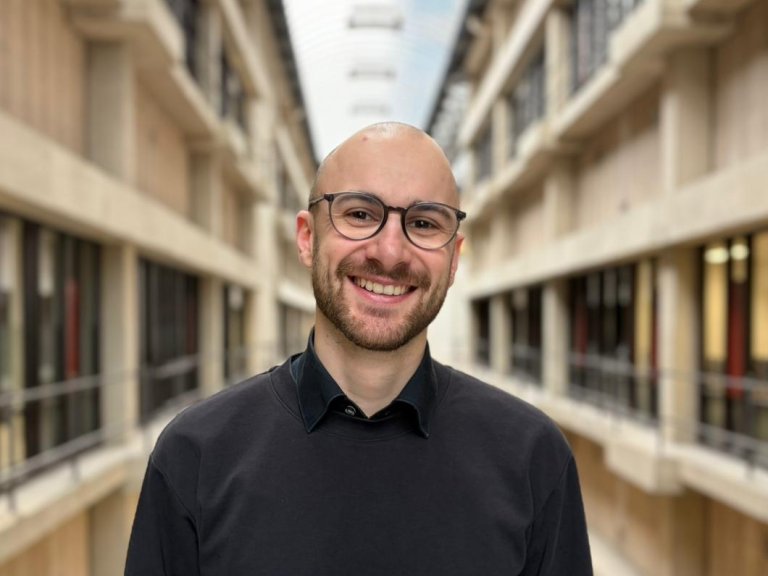
During Postdoc Appreciation Week, we are once again shining a spotlight on the postdoctoral researchers at Amsterdam Cardiovascular Sciences. Postdocs are a vital part of our institute: they contribute to groundbreaking research, mentor young scientists, and bring new perspectives. In this series of short articles, we introduce some of our postdocs to you. We asked them about their research, their motivations, and their experiences as postdocs. Get to know the people behind the science and be inspired by their stories! Today in the spotlight: Nico Schramma, postdoctoral researcher at the Department of Medical Biochemistry.
What impact do you hope your research will have on the field of cardiovascular science or on society?
I hope to contribute to a fundamental understanding of the leukocyte recruitment cascade and, more broadly, the mechanics underlying vascular leakage. I view cells as complex, active materials whose mechanical properties — including adhesion, migration, deformability, and contractility — collectively determine the mechanical integrity of tissues and organs, including the vasculature.
This perspective highlights an important link between cell mechanics and health: changes in cellular material properties can profoundly affect tissue function. By studying vascular integrity and immune cell extravasation from a mechanistic viewpoint, I hope to understand how cell mechanics can be "tuned" and ultimately identify new opportunities for treating vascular diseases and improving vascular health.
What do you enjoy most or find most challenging about working as a postdoc, and do you have any tips for other early-career researchers?
Working as a postdoc allows me to develop my own research while continuously learning from others. I enjoy discovering new techniques and approaches, while also sharing my own knowledge, experimental methods, and analytical perspectives. To me, research is a collaborative process where everyone can contribute and learn from each other, no matter the academic status (student, PhD, postdoc, professor) or scientific background. Realizing this, it has become very important to me to help create spaces for this scientific exchange, in the form of workshops, symposia, and meetings.
I value the flexibility of academic life, from experiments, data analysis, and publications to teaching, presenting, networking, outreach, workshops, and grant writing, although balancing these responsibilities can be challenging.
Most importantly, I believe in continuous development. Failed experiments and rejected grants are opportunities to reflect, learn, and grow. Looking beyond one's own project also opens new perspectives, collaborations, and communities.
Postdoc appreciation week
This week (21–25 September), the Netherlands is hosting the second edition of Postdoc Appreciation Week NL (PAW_NL).
Events are taking place across the country. This is your opportunity to connect, learn, and celebrate the contributions of postdoctoral researchers at both local and national level.
The program of events at Amsterdam UMC can be found on the Postdoc Network Amsterdam UMC website.