

Age shapes the course of MS
Using data from the Amsterdam MS Cohort, Kaçar investigated how MS develops over time and how new biomarkers can support more personalized care. Her findings show that age plays a central role in the disease course. Inflammatory disease activity, such as relapses and new MRI lesions, decreases with age, while neurodegenerative processes become relatively more important. These results suggest that disease progression and treatment considerations may differ substantially between younger and older people with MS.
Blood biomarkers help predict disease progression
The research also highlights the potential of blood-based biomarkers for monitoring disease progression. Levels of neurofilament light chain (sNfL) in blood, a marker of nerve damage, were found to predict future disability particularly during active inflammatory phases of the disease. This supports the use of sNfL as a biomarker for tracking disease activity and neurological damage in people with MS.
Eye scans provide a window into brain health
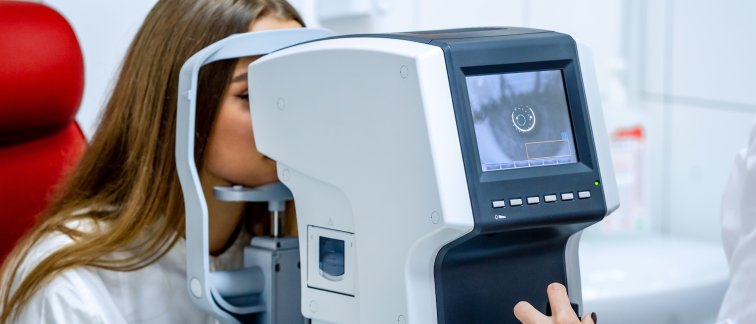
In addition to blood biomarkers, Kaçar showed that Optical Coherence Tomography (OCT), a non-invasive eye scan, provides valuable information about structural damage in the central nervous system. Damage to the retina and optic nerve was strongly associated with brain atrophy, physical disability and cognitive decline. These findings indicate that OCT may offer a simple and accessible way to monitor disease progression in clinical practice.
Exploring new biomarkers
The study also explored vitreous haze, a measure of cloudiness in the eye, as a potential new biomarker. People with MS who showed vitreous haze often had a more severe disease course and lower brain volume. Although the clinical significance of these findings requires further investigation, they may provide new clues for understanding and monitoring neurodegeneration in MS.
Towards more personalized MS care
Together, these findings demonstrate how combining clinical information with MRI, blood biomarkers and eye examinations can provide a more complete picture of disease progression. This may help clinicians tailor treatment and monitoring strategies to individual patients, bringing MS care a step closer to precision medicine.
About the Amsterdam MS Cohort
The Amsterdam MS Cohort is one of the 25 cohort studies connected through Amsterdam Cohort Hub (ACH). The cohort follows people with multiple sclerosis over time and combines clinical assessments with imaging, biomarker and cognitive data. By collecting longitudinal data, the cohort contributes to a better understanding of disease progression and supports the development of more personalized approaches to care.
This research was conducted using data from the Amsterdam MS Cohort. Donations to the Stichting Steun MS Centrum Amsterdam make this unique cohort possible.