


The research findings of Supiot and colleagues reveal that stress alters a multi-branched circuit running from the medial prefrontal cortex (mPFC) to the lateral hypothalamus (LHA). These results open up important new avenues for understanding and potentially treating stress-induced eating behaviours.
How stress flips the switch on fat intake
The LHA is a well-known hub for feeding, but how stress hijacks this system has remained unclear. Using in-vivo electrophysiological recordings and advanced circuit dissection and manipulation techniques, the researchers first demonstrated that direct stimulation of this mPFC-LHA pathway increases fat intake. However, in the context of stress-induced fat intake, the circuit behaves differently. The team found that stress leads to a weakening of mPFC inputs onto LHA glutamatergic neurons. Crucially, they discovered that inhibiting these LHA glutamatergic neurons during stress completely prevents the binge eating response.
Opposing forces bias the brain toward binging
Importantly, the study reveals that these stress-induced changes are not uniform across the glutamatergic population in the LHA. Instead, stress modulates the mPFC-LHA glutamatergic connection depending strictly on their downstream target areas: VTA-projecting LHA glutamatergic neurons are strengthened, consistent with their role in promoting food intake; peri-PVN-projecting LHA glutamatergic neurons, which are known to reduce food intake, are weakened. These opposing forms of plasticity ultimately bias the entire circuit toward increased food intake after stress.
Overall, this work identifies a complex, multi-branched mPFC-LHA network that is indispensable for stress-induced eating, highlighting a precise circuit-level mechanism for how the brain responds to adversity by altering dietary habits.
Read the article published in Nature Communications: A prefrontal cortex-lateral hypothalamus circuit controls stress-driven increased food intake
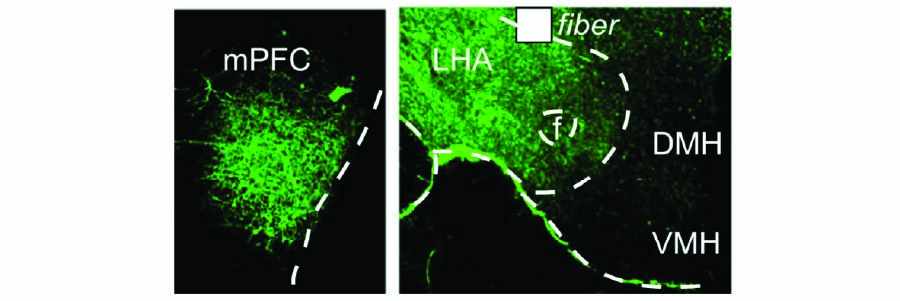
Image from Supiot et al., Nat Commun 17, 4620 (2026). Stress-recruited mPFC neurons project to the lateral hypothalamus. Viral targeting and optogenetic manipulation of this neuronal ensemble leads to overconsumption of palatable food, mimicking the effects of stress on feeding behaviors.