

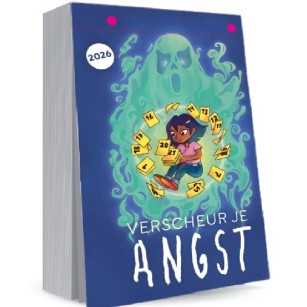
Anxiety disorders are common, often chronic and prone to relapse: at this moment, 15% of the Dutch population has an anxiety disorder. APH researchers Neeltje Batelaan, psychiatrist and professor of anxiety related disorders, and Willemijn Scholten, psychotherapist and senior researcher, both of Amsterdam UMC and GGZ inGeest, want to bring their expertise on anxiety beyond the walls of mental health care. The result: the 'Verscheur je angst' ('Tear up your anxiety') tear-off calendar, distributed free of charge. By tearing off a page each day, people literally and symbolically tear away a small piece of their anxiety.
From inauguration gift to 2,850 calendars
The idea arose when Batelaan was appointed professor of anxiety related disorders at Amsterdam UMC and, as her inauguration gift, asked to be given the chance to create an 'anxiety calendar'. That idea stuck, Scholten says. "We are always looking at how to better share our knowledge: with patients, but also with society at large, including people who are not yet patients"

A daily incentive after treatment
Even after successful treatment, anxiety remains an underlying vulnerability that can always resurface, Batelaan explains. "When people become afraid of something again, they really must not start avoiding. But everything in their body screams that they should not enter that situation." Keeping up that motivation on your own is difficult, which is why the calendar serves as a daily push for people who have completed their treatment.
According to the researchers, the biggest gains lie in the group that does not yet have many complaints, and in relapse prevention. "That is exactly the group we are now trying to empower," says Batelaan. The calendar therefore also targets people with anxiety complaints who are not (yet) in treatment, and next of kin. How next of kin respond can sometimes influence the course of the disorder, Batelaan explains. The calendar advises partners how to stand beside someone without taking over too much.

Developed with the people it serves
The calendar translates research knowledge from Amsterdam UMC and GGZ InGeest: epidemiology, treatment, relapse prevention and clinical expertise, into brief, practical daily messages and exercises grounded in cognitive behavioral therapy, psychoeducation and empowerment. Experts by experience, patients and therapists contributed content, and patient and professional networks supported distribution.
The calendar also brought science and art together. Through a call on LinkedIn, well-known Dutch creators were invited to contribute, and they donated their work free of charge: comic strips by cartoonist Sigmund, a poem by Jesse Laporte, songs by Froukje and material from Omdenken.
GGZ InGeest and Amsterdam UMC jointly made it possible to print 2,850 copies, all distributed free of charge. To finish the calendar, the team of the academic workplace anxiety spent two days at a retreat. "We usually go there to write a scientific article, but this time we were literally cutting and pasting and inventing rhymes," Scholten recalls. "It was wonderful team building."
Overwhelming response
A pre-order link on LinkedIn had to be removed within a day. "It completely took off. We simply could not keep up with the demand," says Scholten. Emails are still coming in, such as from a mother whose son with multiple anxiety disorders "looks at the calendar every day". GGZ InGeest now posts a calendar page on LinkedIn every week, until the end of December.
Looking to the future
What do they hope to achieve? "That people feel supported and know what to do, and that our knowledge does not remain within mental health care," says Batelaan. "That is where the real gain lies for anxiety disorders." Scholten: "And that people recognize themselves and no longer feel alone." The researchers also hope to reduce the stigma around anxiety and OCD. "Everyone is ashamed, so everyone stays in their own little cocoon, feeling miserable," says Batelaan. "It would be good if people noticed they are not alone, 15% of the population currently has an anxiety disorder, and that is not about being afraid of spiders," Scholten adds.
Talks with publishers about a follow-up in book form, with 365 days of advice, are in an early stage. And there is still much to gain: anxiety gets far less attention and funding than depression, even though it is just as common and also impactful. "We see in daily practice how much people suffer, and how much knowledge is still missing," says Scholten. "That is what drives us."
Curious about the calendar? Follow GGZ inGeest on LinkedIn: every week, until the end of December, a new page is posted