Recently, several prestigious prizes and grants have been awarded to our AI&I members. Learn more about these accomplished individuals and their projects in the article below!
€2.7 Million for PATHFINDER | Petra Mens and Henk Schallig
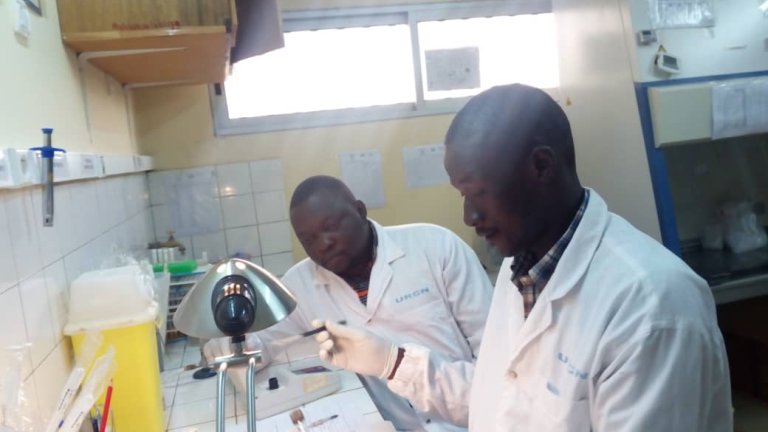
On 1 October 2026, the Laboratory of Experimental Parasitology (Medical Microbiology & Infection Prevention), led by Dr. Petra Mens and Dr. Henk Schallig, launched PATHFINDER, a project funded by a €2.7 million grant from EDCTP3 (EU). The project is carried out in collaboration with Imperial College London (coordinator), the University of Ghana (Accra), the Clinical Research Unit Nanoro of the Institut de Recherche en Sciences de la Santé (Ouagadougou, Burkina Faso – scientific lead), and ProtonDx, a UK-based company specializing in innovative diagnostics.
PATHFINDER will test a new diagnostic platform: a lab-on-a-chip developed by ProtonDx that detects malaria, bacterial and viral infections, and tuberculosis (including co-infections), based on differences in the host's gene expression response. The study will be conducted with 1,000 children in Burkina Faso and Ghana. In addition, the Laboratory of Experimental Parasitology will play an essential role in building local research capacity by supervising MSc and PhD students.
"The PATHFINDER project will provide evidence for a disruptive approach, with the potential to transform the diagnostic ecosystem and have a wide-reaching impact on healthcare delivery in sub-Saharan Africa."
Dr. Henk Schallig | Principal Investigator, Laboratory of Experimental Parasitology, Medical Microbiology & Infection Prevention
The need for such a platform is urgent. Diagnostics represent the biggest gap in the cascade of care for priority infectious diseases in sub-Saharan Africa. Prompt, accurate diagnosis is essential to start the right treatment in time, yet in many resource-limited settings, diagnosis relies on clinical symptoms alone, i.e. fever. As a result, a viral infection may be treated with antibiotics, while life-threatening malaria goes untreated. In PATHFINDER, the researchers will take the newly developed platform beyond proof-of-concept, evaluating it in real-life clinical settings to determine the cause of febrile illness in children.
Best Poster Presentation Award ESPID 2026 | Amber Schotting
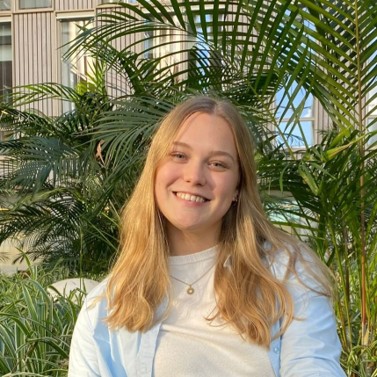
AI&I PhD candidate Amber Schotting has received the Best Poster Presentation Award at the 2026 Annual Meeting of the European Society for Paediatric Infectious Diseases (ESPID)!
She received the award for her poster titled "Non-Polio Enterovirus A71 and D68 Infection of Human Neuromuscular Organoids Reveals Distinct Mechanisms of Neuromuscular Impairment". As ESPID announces these awards a year after the meeting rather than during the event itself, the notification came as a wonderful surprise to Amber.
The research
Amber's research focuses on understanding why non-polio enteroviruses such as EV-A71 and EV-D68 can cause polio-like symptoms, including paralysis, in infected children. To investigate this, she used human neuromuscular organoids: a model that captures the interplay between neurons and muscle. By infecting these organoids with EV-A71 or EV-D68, she found that although both viruses can cause similar neurological disease, they appear to do so through different mechanisms. These findings bring the field one step closer to understanding enterovirus-induced paralysis and developing targeted treatments, while highlighting neuromuscular organoids as a valuable model for studying neurotropic viruses.
The conference
ESPID 2026 brought together an international and multidisciplinary community of clinicians, researchers, and public health experts in paediatric infectious diseases. For Amber, the meeting was a valuable opportunity to present her work, learn about the latest advances, and connect with colleagues from different fields. With its focus on climate change and emerging infectious diseases, the meeting also highlighted how changing environments may influence infectious disease patterns in children.
Best Presentation Awards Dutch Rheumatology Autumn Meeting 2026 | Tjalle Dijkstra and Sam Groothuizen
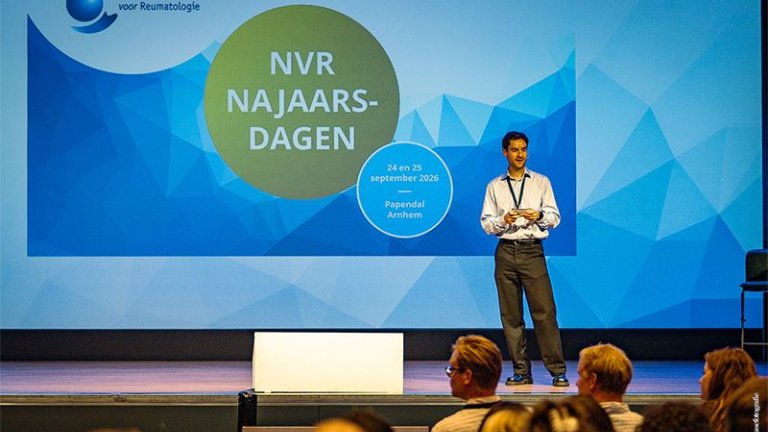
AI&I PhD candidates Tjalle Dijkstra and Sam Groothuizen have received the awards for Best Presentation at the 2026 Autumn Meeting (Najaarsdagen) of the Dutch Society for Rheumatology (NVR)!
They won in the categories of basic/translational research and clinical research. A clean sweep: both presentation awards went to Amsterdam!
The Najaarsdagen is the annual scientific meeting of the Dutch Society for Rheumatology, held this year on 24 & 25 September in Arnhem. The meeting brings together rheumatologists, researchers and other professionals to share the latest scientific and clinical developments in rheumatology.
Modeling Lymph Node–Synovium Immune Crosstalk in Rheumatoid Arthritis Using a Human Lymph Node–on-a-Chip Platform - Tjalle Dijkstra
Rheumatoid arthritis (RA) is a chronic autoimmune disease driven by sustained immune activation, involving crosstalk between lymph nodes and inflamed joint tissue (synovium). How these tissues influence each other during disease remains poorly understood, largely due to the lack of human ex vivo models capturing inter-organ complexity.
In this project, PhD candidate Tjalle Dijkstra and his team are developing a multi-organ-on-a-chip platform that connects an inflamed synovial organoid to a lymph node model. This allows them to study RA in a fully human, physiologically relevant microenvironment, with the goal of understanding how autoimmunity is maintained, and how it can be targeted therapeutically.
"I was grateful to receive this award. It was encouraging to see the rheumatology field recognize the value of human ex vivo models, which allow us to study disease while reducing the need for animal research."
Tjalle Dijkstra, PhD candidate, Departments of Rheumatology and Clinical Immunology, Experimental Immunology, and Molecular Cell Biology and Immunology, Amsterdam UMC.
Changes in Sodium [18F]Fluoride uptake on PET/CT in joints and entheses of psoriatic arthritis patients after 12 weeks of secukinumab treatment - Sam Groothuizen
Psoriatic arthritis (PsA) is a chronic inflammatory disease in which TNF and IL-17 are key drivers of pathology. Chronic inflammation can result in structural damage with new bone formation (NBF). Early detection of NBF is challenging, as conventional radiography only detects changes after several years.
Sodium [18F]Fluoride (Na[18F]F) PET/CT enables visualization and quantification of molecular NBF. In this project, Sam and the research team investigate changes in NBF before and 12 weeks after secukinumab treatment in the peripheral joints and entheses of PsA patients using Na[18F]F PET/CT.
Their findings show that molecular new bone formation decreased in some joints following treatment, while other sites, especially degenerative lesions, remained stable or showed increased activity. Interestingly, these changes did not closely correlate with clinical assessments of joint and entheseal tenderness or swelling, suggesting that PET/CT may provide additional insights into structural changes in PsA.
“I’m very happy to have received this award, especially as it was my last conference during my PhD. It was a lovely way to end this chapter, and I’m glad to see that there was interest in PET/CT imaging at the conference.”
Sam Groothuizen, PhD candidate at Department of Rheumatology and Clinical Immunology