
In our series of 'Meet the AMS scientist', we shine the light on outstanding AMS researchers and dive into their background, what drives them, what their work brings them and what they bring to their work. These interviews are also shared on the AMS LinkedIn account, feel free to share within your network!
A black box: a system in which we can observe what goes in and what comes out, but not necessarily understand what happens in between.
In many ways, the human brain remains one of the most fascinating black boxes of all. We can observe its exceptional ability to coordinate movement, respond to changes, and adapt to new circumstances. Yet much of how it accomplishes these tasks remains a mystery. For Ali Ilez, understanding what happens inside that box has become the motivation behind his research.
As a physiotherapist, Ali was initially interested in how the human body moves and how rehabilitation can help restore physical function. But throughout his studies, he found himself repeatedly returning to the same questions: when investigating the role of foot muscles in balance, he wondered what was happening in the brain to coordinate those movements; when studying people with diabetes, his attention shifted towards the neurological changes associated with the condition; and when evaluating rehabilitation techniques, he wanted to understand not only whether patients improved, but also what changed in their brains.
He wanted to bridge the gap between fundamental research and clinical practice, using objective measurements to better understand why certain rehabilitation practices work and how they might be improved. That ambition eventually brought him to Amsterdam, where he now investigates how the brain controls walking.
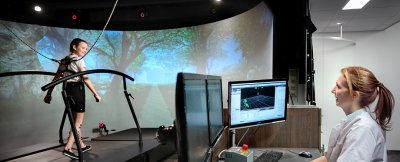
Walking is something most of us do without consciously thinking about it. Yet even a seemingly simple action requires constant coordination between the brain, nervous system, and muscles. Encounter an obstacle, change direction, or lose your balance, and the system must respond immediately and adequately.
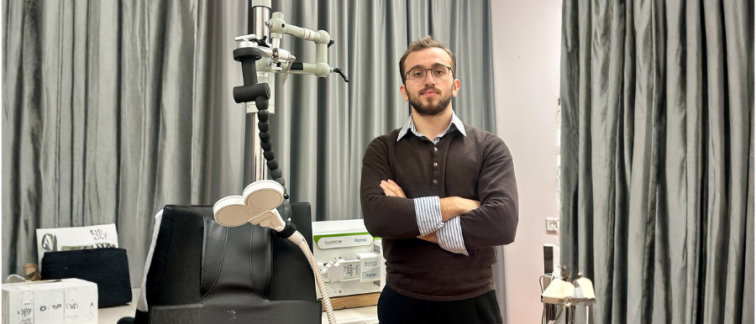
Ali is particularly interested in how the brain’s contribution to walking changes under different conditions of stability. To investigate this, he uses transcranial magnetic stimulation (TMS), a technique that applies brief magnetic pulses to stimulate areas of the brain involved in movement. By measuring the responses in leg muscles during different phases of walking, he can investigate how the communication between the brain and muscles changes depending on the demands of the task. This allowes him a peak inside the black box.
The ultimate goal is not simply to understand the brain for the sake of understanding it, but to use that knowledge to improve rehabilitation.
His journey to Amsterdam was also a deliberate step towards that ambition. During his master’s studies in Turkey, Ali began exploring opportunities to pursue research abroad. Although his scholarship means that he will eventually have to return to Turkey, Ali is concentrating on the opportunities available to him now. He hopes to deepen his understanding of the neural mechanisms underlying movement and, if possible, extend his research towards clinical populations.
For Ali, research does not feel entirely like work. He describes it almost as a hobby, something he genuinely enjoys doing, even when the questions become complicated and the answers remain elusive. He believes that curiosity and enjoyment are essential for anyone considering a career in science.
Perhaps that is what makes the brain such a compelling subject for him. Every answer seems to reveal another question, another mechanism to investigate, another connection that is not yet fully understood.
The brain may still be something of a black box, but for Ali, opening some windows and exploring what’s inside is the challenge he was looking for.
Find the article also on our LinkedIn.
Written by Elianne Prange (Communication Officer AMS)