
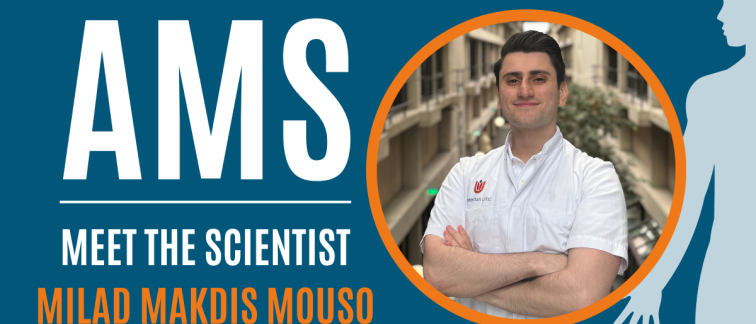
In our series of 'Meet the AMS scientist', we shine the light on outstanding AMS researchers and dive into their background, what drives them, what their work brings them and what they bring to their work. These interviews are also shared on the AMS LinkedIn account, feel free to share within your network!
Major changes can divide life into a before and an after. Yet what comes after is shaped not only by what has changed, but also by how people adapt to what remains. This is something Milad Makdis Mouso encounters regularly in his research, where he meets people years after cancer treatment and major surgery and sees the many different ways in which they have adapted and rebuilt their lives.
It is a theme that also resonates with his own journey. Ten years ago, Milad came to the Netherlands from Syria with his family. Today, he combines his medical studies with a PhD at Amsterdam UMC. His experiences and those of his patients are, of course, very different. Yet both have contributed to his fascination with people’s remarkable ability to adapt when circumstances fundamentally change.
Milad’s research focuses on patients who have undergone surgery for soft tissue sarcoma. Removing a tumour often requires removing some of the healthy tissue surrounding it as well. Depending on the location and extent of the tumour, this may include muscles, tendons, ligaments or, in some cases, bone. Although this is necessary to treat the cancer, the loss of these structures can have lasting consequences for mobility and physical function.
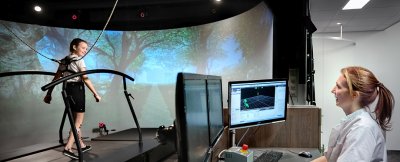
Rather than focusing on a single outcome, Milad studies recovery from several perspectives. He measures muscle strength, analyses patients’ walking patterns and energy expenditure during walking, and performs physical examinations. His research also explores body image. In a future part of the project, MRI scans will be used to investigate how the amount of muscle removed during surgery relates to patients’ physical function afterwards.
Collecting all these measurements means spending a considerable amount of time with each participant. A complete assessment can take around six hours. For Milad, however, this time also provides something that measurements alone cannot capture: the opportunity to hear how patients’ lives have unfolded after treatment. Because every patient has a different experience.
A sarcoma does not occur in exactly the same location in every person, and surgery does not affect the same structures in every patient. The differences continue long after the operation. Some people have to change jobs, while others find ways to return to activities they enjoy despite having lost muscle tissue during surgery. Experiences like these raise important questions about how the body adapts and compensates after major physical changes.
A better understanding of these adaptations could ultimately help clinicians anticipate what individual patients may need after treatment and improve rehabilitation and long-term care. Surviving cancer is, after all, only part of the story.
Milad’s interest in these questions developed during his medical studies. He had known from an early age that he wanted to become a doctor and soon developed a particular interest in research and orthopaedics. What appealed to him was the potential for research to have an impact beyond the individual patient. Findings can improve care for many patients, provide knowledge that other physicians can use and create a foundation on which future researchers can build.
Patients, he believes, place an enormous amount of trust in healthcare professionals when they allow them to make decisions that may profoundly affect their lives. Being given that trust is something he considers an honour.
For now, Milad is continuing to collect data while completing his medical training. In the future, he hopes to pursue a career in a field centred on movement and musculoskeletal function, with orthopaedics as his main ambition.
Both Milad’s own journey and the stories he encounters through his research have strengthened his interest in how people respond to profound change. Recovery does not always mean returning to exactly what existed before. Sometimes it means adapting to a new situation and finding a way to go on from there.
After a major change, life may not return to what it once was. But that does not mean it stops moving forward.
Find the article also on our LinkedIn.
Written by Elianne Prange (Communication Officer AMS)