
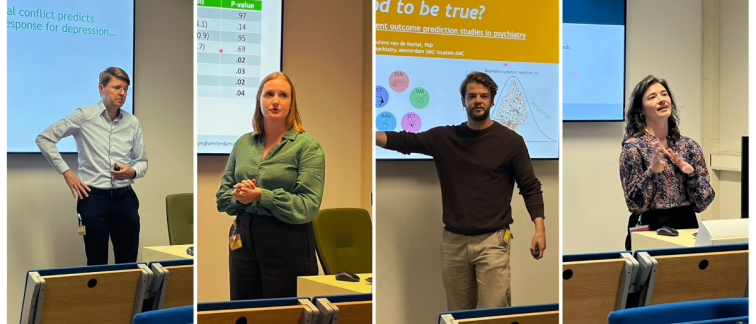
The afternoon started with postdoctoral researcher Marieke van der Pluijm, who took the audience through her PhD research on neuromelanin-sensitive MRI and its potential as a marker of treatment resistance in schizophrenia. Since 25–30% of patients with schizophrenia are treatment resistant, Marieke showed that neuromelanin-sensitive MRI can differentiate between patients with schizophrenia and healthy controls. Potentially, it can help to avoid delays in effective treatment and unnecessary side effects.
The second speaker, postdoctoral researcher Laurens van de Mortel, challenged the audience to think critically about performance metrics in psychiatric research and how predictive performance can be artificially inflated through "double dipping" in data analysis. He published a communication letter, in which he discussed a meta-analysis on predicting treatment outcomes in depression using MRI, together with Guido van Wingen, which revealed evidence of data leakage in the included machine learning studies. Overall, Laurens highlighted the importance of critically evaluating reported diagnostic accuracies.
Finally, postdoctoral researcher Daphne Boucherie concluded the session by presenting her work on the rapid and delayed reorganization of functional brain networks following S-ketamine administration. She combined pharmacological MRI with neurobiological information to assess whether receptor-gradient-enriched functional connectivity is sensitive to a pharmacological challenge with S-ketamine. Overall, the study suggests that S-ketamine's effects on functional connectivity networks defined by latent receptor components are dose-dependent.
About Brain Imaging
The Brain Imaging research program is one of the nine research programs within Amsterdam Neuroscience, led by Menno Schoonheim, Matthan Caan, Elsmarieke van de Giessen, and Martijn Beudel. This program aims to make a difference in the field of neuroimaging, as well as provide services to other medical disciplines, through the optimization of infrastructure, analyses, techniques, and technologies.
Visit the Brain Imaging page