

The human brain has unique cognitive abilities compared to animals. However, it is also vulnerable to diseases that bring cognitive decline and neurodegeneration, such as Alzheimer's. What makes the human brain so different? Neuroscientist Goriounova's team thinks the answer lies in the function of neurons in our brains. Over the course of evolution, our neurons could have developed properties to process information faster and more efficiently in a larger brain, but which also made the neurons more vulnerable.
Neurons
Previously, Goriounova showed that the human brain holds specialized neuron types with distinct properties associated with IQ scores. These neurons could be crucial to human cognition because they are selectively lost in cognitive impairment. How these neurons function and form connections in the human brain is still unknown.
In her ERC proposal, Goriounova will test her prediction that cortical computation in the human brain depends on a highly interconnected network of these special types of neurons, which form fast and strong connections and can be fine-tuned by specific receptors to increase computational power.
Live brain tissue studies
These questions can only be investigated in adult living human neurons in their intact networks. This is extremely challenging because of the difficult access to human brain cells. Goriounova therefore collaborates with several hospitals in the Netherlands treating people with tumors or epilepsy. During surgical treatment, the neurosurgeon also removes a small piece of healthy cortical tissue to access the focus of the disease. This human brain tissue can be kept alive and used to study how neuronal cells function in their intact connections.
By collecting preoperative data from the same patients, the team can now link neuronal function to live brain network activity and cognitive scores of these patients. These methods make it possible to answer the question of the specialized function of human neurons relevant to cognition.
European Research Council
The ERC Consolidator grant is a highly competitive personal grant from the European Research Council that enables excellent researchers to consolidate and expand their independent research line. Goriounova will receive €2 million for her project HumanCircuits. Read more about the 2025 ERC Grants.
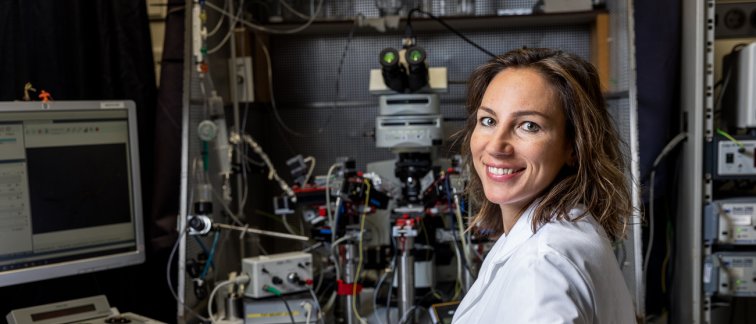
Dr. Natalia Goriounova is Associate Professor the Center for Neurogenomics and Cognitive Research (CNCR), at Vrije Universiteit Amsterdam as well as a researcher in cellular & molecular mechanisms within Amsterdam Neuroscience (Systems & Network Neuroscience). Her research focuses on understanding which properties of human neurons and circuits evolved in the human brain to support uniquely human types of cognition. By studyingpropertiesof neurons in neurosurgical tissue from human patients she attempts to link thefunction, neuronal structure, the structure of the cortical layers and in vivo brain activity to cognitive ability of the same subjects. Currently, her team investigates how genes associated with human intelligence act in neurons of the human brain to support circuit function and cognition.
Photo by Marieke de Lorijn