

Patients who have had high-risk bowel polyps removed are often monitored for years. But are all these examinations really necessary? The European Polyp Surveillance (EPoS) project is investigating whether patients can safely wait longer between colonoscopies. The first results are promising and were recently published in The New England Journal of Medicine. Gastroenterologist Evelien Dekker of Amsterdam UMC discusses what prompted the research, its first findings, and the search for better ways to prevent colorectal cancer (CRC).
For almost twenty years, prof. Evelien Dekker has worked at Amsterdam UMC on detecting and preventing colorectal cancer. After training as an internist and gastroenterologist, she was asked to establish a colorectal cancer research group at a time when care for people at increased risk of CRC was not yet systematically organized. “Patients with genetic risk factors for CRC were already coming to us back then, but the care wasn’t really organized. There was no dedicated outpatient clinic, for example, and very little structured research,” Dekker says.
Initially, research focused on improving the image quality of endoscopes and the detection of polyps, small growths in the lining of the bowel. Today, this focus has shifted towards a different question: which patients benefit from regular colonoscopies, and who might safely undergo fewer examinations?
Preventing colorectal cancer before symptoms appear
Most colorectal cancers develop from polyps. It may take many years for a polyp to become cancerous, so detecting and removing polyps early can prevent colorectal cancer. “Unlike many cancers, CRC has a detectable and curable precursor: polyps, which gives us the opportunity to perform early interventions and prevent these polyps of turning into cancerous tumors. The problem is that polyps usually cause no symptoms at all,” Dekker explains.
People at increased risk, for example because of genetic risk factors or long-term inflammation of the bowel, may therefore undergo regular colonoscopies. For people with no known increased risk, a colonoscopy is considered too burdensome as a first screening test. For those people, the Dutch CRC screening program uses the fecal immunochemical test (FIT), which detects tiny amounts of blood in stool. A positive FIT is followed by a colonoscopy.
Yet, finding polyps also creates a dilemma; while most colorectal cancers arise from polyps, only a small proportion of polyps eventually become cancerous. Because it is not yet possible to reliably predict which ones will progress, polyps are generally removed when detected.
Are current surveillance intervals still appropriate?
After polyp removal, patients may be advised to return for surveillance colonoscopies. Under the 2019 Dutch surveillance guideline, high-risk patients were generally scheduled for a follow-up colonoscopy after three years, while a five-year interval could apply to those at lower risk. However, these intervals were partly based on studies conducted when colonoscopies were less accurate and small polyps were more frequently missed. “If you looked again three years later, you would sometimes simply find a polyp that had already been there the first time,” says Dekker.
Since then, endoscopic imaging and polyp detection have improved considerably. The quality of examinations is also monitored through measures such as the adenoma detection rate, which reflects how often an endoscopist detects adenomas, a type of polyp that can develop into cancer. This raises an important question: if we are now better at finding and removing polyps, do patients still need to come back as frequently?
The answer matters for both patients and the healthcare system. Colonoscopies can be burdensome, carry a small risk of complications, and require considerable time, staff, and resources. Fewer unnecessary check-ups could ease the burden on patients and free up capacity for other essential examinations.
The EPoS studies: can surveillance intervals be extended?
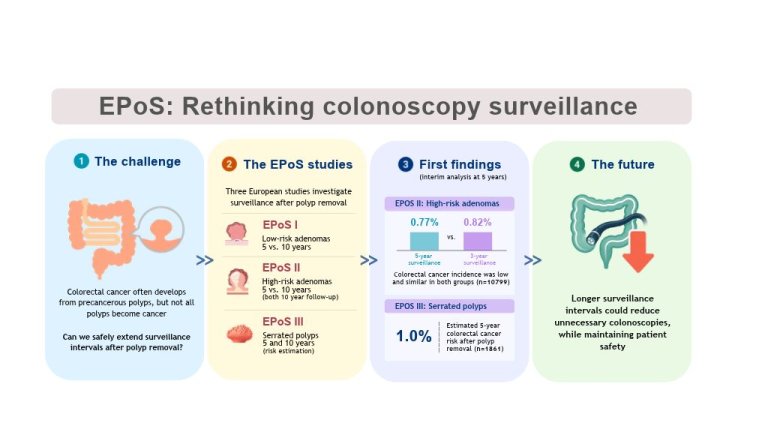
To investigate this, researchers established the EPoS project, involving hospitals and clinics from eight European countries. It consists of three studies examining surveillance after the removal of different types of polyps. The first findings from EPoS II and III were recently published in The New England Journal of Medicine. (Colonoscopy Intervals and Colorectal Cancer Incidence after Adenoma Removal - PubMed and Colorectal Cancer Risk among Patients with Serrated Polyps - PubMed).
EPoS I focuses on patients with low-risk adenomas. One group receives colonoscopies after five and ten years, while the other is examined only after ten years. The aim is to determine whether the five-year check-up can safely be skipped. The long-term results are still awaited.
EPoS II studies patients with high-risk adenomas, such as larger or multiple polyps. In this study, 10,799 patients were assigned to a first surveillance colonoscopy after either three or five years. Both groups are also followed up after ten years, to assess whether the longer interval is equally safe.
The interim results are promising. Colorectal cancer incidence was very low in both groups: 0.77% in the five-year group, compared with 0.82% in the three-year group. The findings suggest that waiting five years for a follow-up colonoscopy may be as safe as returning after three years. Moreover, extending the interval between check-ups reduced the number of follow-up colonoscopies by almost 50% during the study period.
EPoS III follows patients with certain higher-risk serrated polyps, a type of polyp which is flat and therefore more difficult to detect. An estimated 15-30% of colorectal cancers develop through the serrated pathway, but the risk of recurrence after removing these polyps is still unknown. The study follows patients with examinations after five and ten years to better understand that risk.
Among the 1,861 participants, seven developed colorectal cancer during five years of follow-up, corresponding to an estimated five-year risk of 1.0% after statistical adjustment. Advanced serrated lesions were found in 7.5% of participants, and advanced adenomas in 7.2%. The estimated risk of colorectal cancer after removal of these serrated polyps was relatively low and appeared broadly comparable to that of patients with high-risk adenomas. Because EPoS III is an observational study, however, it does not establish whether a longer surveillance interval is as safe as a shorter one. Its findings do provide valuable evidence for improving surveillance recommendations.
While these first findings are promising, the ten-year analyses will provide further insight into whether longer surveillance intervals offer sufficient protection in the long term.
The future: predicting which polyps will become cancerous
Beyond these findings, an important question remains: why does one polyp eventually develop into CRC while another remains harmless? And why does this happen in some patients but not in others?
“That is still the holy grail, really,” says Dekker. “Why some polyps actually develop into colorectal cancer and others don’t, we don’t know yet.”
Further research into the gut microbiome and the molecular characteristics of polyps could help explain these differences and eventually make it easier to predict which patients are more at risk.
Ultimately, Dekker hopes that colorectal cancer prevention will become increasingly targeted, with more intensive monitoring for patients who may benefit from it and fewer unnecessary examinations for those at low risk. Perhaps in ten years, a colonoscopy will no longer be necessary at every follow-up. The EPoS studies are an important step in that direction. They suggest that good prevention does not always mean examining patients more often. Above all, it means providing the right care to the right patient at the right time.
Authors
Ana Avramovic
Kenneth Overberg