

It was national world thyroid day on May 25th, and Dutch thyroid day on June 5th. In light of this, we wanted to highlight the thyroid research within AGEM. The Thyroid is one of the focus areas of AGEM and research is performed at the Department of Endocrinology and Metabolism (dr. Eveline Bruinstroop and dr. Anne van der Spek), department of Pediatric Endocrinology (Prof. dr. Paul van Trotsenburg, dr. Nitash Zwaveling – Soonawala and dr. Christiaan Mooij) and the Endocrine Laboratory (Prof. dr. Anita Boelen, Prof. dr. Annemieke Heijboer and dr. Jacquelien Hillebrand).
Anita Boelen is a professor in Thyroid Hormone Metabolism and has been involved in thyroid research performed at the Endocrine laboratory from the beginning. Her group investigates how the thyroid hormone system works and what happens when it goes wrong. Very relevant research as Professor Boelen explains “Nearly every cell in the human body carries a receptor for thyroid hormones and are regulated by them”.
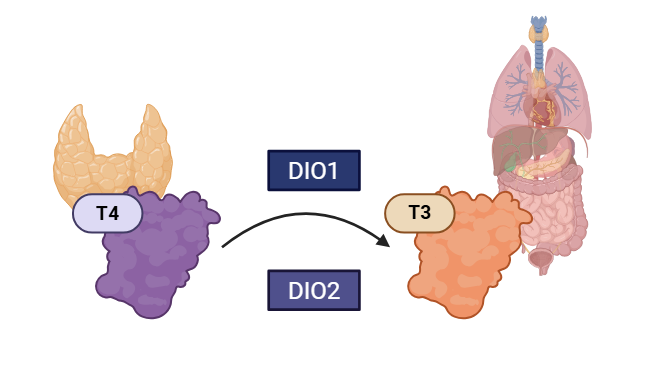
The thyroid gland mainly produces T4, a prohormone that is converted by tissues into the active hormone T3 by deiodinase type 1 and type 2. The vast majority of thyroid hormones in the blood are bound to proteins and therefore inactive — only the small free fraction can enter cells via specialized transporters. Once inside the cell, T3 binds to thyroid hormone receptors and regulates cellular activity. Although this system is essential for normal functioning, many aspects of thyroid hormone regulation remain poorly understood, including how it adapts to disease, stress, or metabolic changes. This is precisely what Professor Boelen's group aims to unravel.
Anita originally entered the field through immunology. During her biology studies, she became interested in cytokines and the interaction between stress and the immune system. This eventually led to an NWO-funded PhD project in endocrinology on the influence of cytokines on thyroid hormone metabolism. “It was a combination of immunology and endocrinology that became the basis of my research line,” she says.
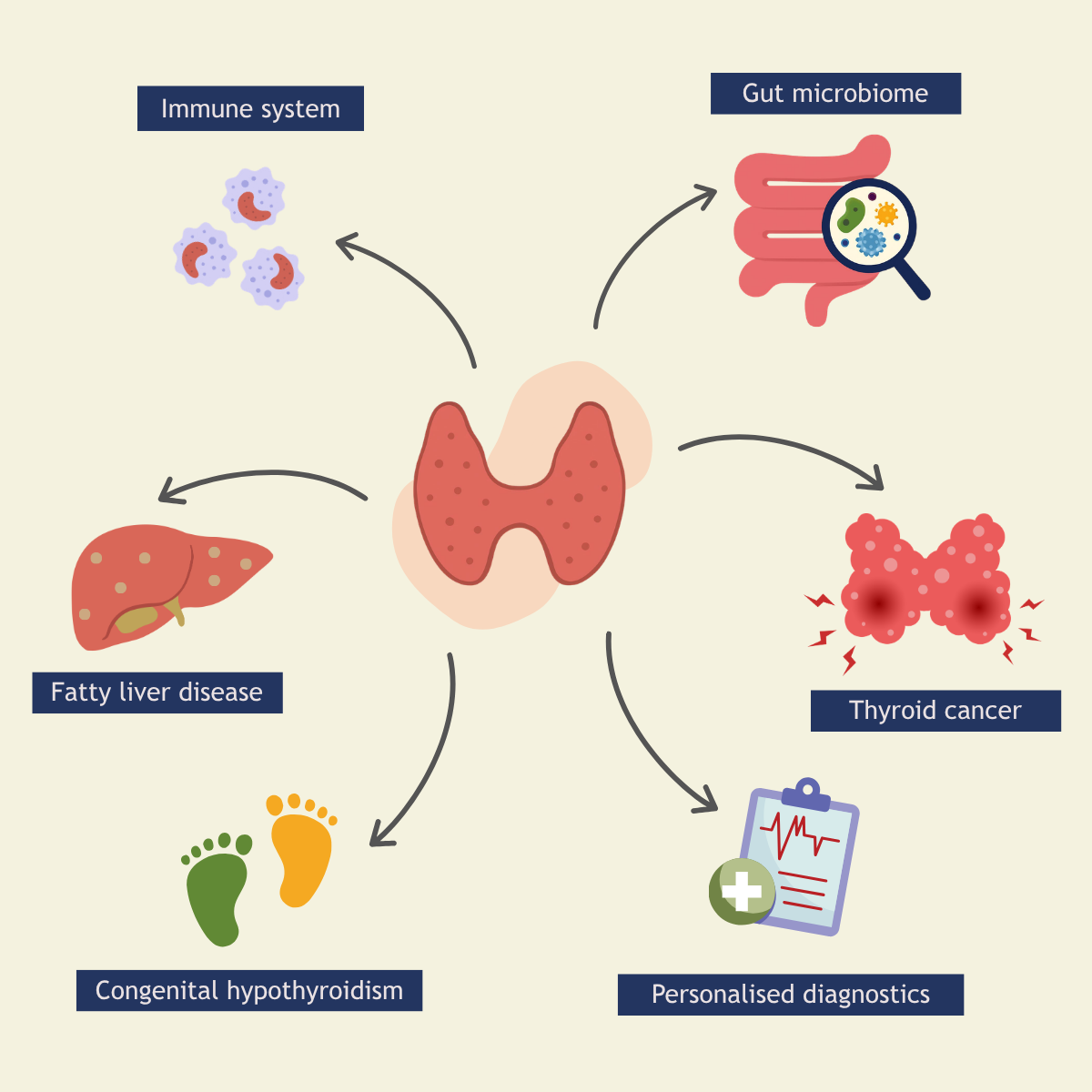
Today, the Endocrine Laboratory investigates thyroid hormones from multiple angles. Some researchers focus on immune cells and inflammation, others on liver disease, diagnostics, neonatal screening, or autoimmune thyroid disorders. Together, the projects reflect how rapidly the field is evolving and how many functions of the human body are influenced. One major research line within the group focuses on the interaction between the thyroid hormones and the immune system. This includes research into how thyroid hormone regulates immune cells, as well as studies into autoimmune thyroid diseases such as Graves’ disease and Hashimoto’s disease, the latter in close collaboration with the department of Endocrinology.
“People often think thyroid research is a solved field because we already have treatments,” Anita says “but many patients still do not fully recover, even when their blood values are considered normal. That means there is still a lot we do not understand.”
Esmée Hoen: Thyroid hormone and the immune system
PhD candidate Esmée Hoen (supervised by Anita Boelen, Anne van der Spek en Eveline Bruinstroop) studies how thyroid hormone affects the immune system, specifically macrophages: immune cells that act as first responders during infection and tissue damage.
“Thyroid hormone is mainly known for its role in growth and metabolism,” Esmée explains. “But there is increasing evidence that it also influences immune cells.”
Her research shows that thyroid hormones can strengthen the defensive functions of macrophages, helping them fight infections more effectively, while at the same time reducing some of their tissue-repair functions. Rather than switching the immune system on or off, thyroid hormones appear to fine-tune the balance and intensity of immune responses.
Esmee’s work builds on earlier research within the group performed by Anne van der Spek, on another set of immune cells, the neutrophils. One of the challenges in this field is that thyroid disorders are often treated quickly, making it difficult to study how untreated thyroid disease affects infection risk in patients.
To better understand these mechanisms, Esmée, Anne, and their collaborators in Cambridge are studying patients with a rare mutation in the thyroid hormone receptor, known as resistance to thyroid hormone alpha (RTH-α). By analyzing infection rates and antibiotic use in these patients, the researchers hope to learn more about how thyroid hormone shapes immune responses in humans.
Ultimately, Esmée hopes her research will increase awareness that thyroid research is far from finished. “We still do not fully know whether patients with well-controlled thyroid disease are also completely healthy at the level of the immune system,” she says.
Xinru Zhang: Thyroid hormone and fatty liver disease
PhD candidate Xinru Zhang (supervised by Eveline Bruinstroop and Anita Boelen) investigates the relationship between thyroid hormone signaling and Metabolic dysfunction-Associated Steatotic Liver Disease (MASLD), and its progressive state, known as MASH. Her work focuses on how thyroid hormone metabolism inside the liver interacts with fat accumulation, inflammation, and fibrosis. Using liver cell models, Xinru studies how diet, and liver-specific regulators influence thyroid hormone activity in the liver.
One important focus of her research is DIO1, the primary deiodinase active in the liver, which converts thyroid hormone into its active form. By experimentally increasing or decreasing DIO1 activity, Xinru investigates how local thyroid hormone metabolism drives fat accumulation and fibrosis development in the liver.
This line of research builds on work by her supervisor dr. Bruinstroop who showed during her postdoc in Paul Yen's lab in Singapore that thyroid hormone signaling may protect against fatty liver disease progression. This idea is supported by emerging therapies such as resmetirom, a selective thyroid hormone receptor-beta agonist recently approved in the United States for fatty liver disease, though not yet in Europe.
“Thyroid hormone signaling in the liver is becoming an important therapeutic MASLD target,” Xinru explains.
In the future, she hopes to expand her work towards immune cells in the liver, such as Kupffer cells and macrophages, to better understand how thyroid hormones, inflammation, and fibrosis interact as liver disease progresses. Ultimately, this research could contribute both to new treatment strategies and to smarter, less invasive diagnostics for patients with fatty liver disease.
Anne van der Spek: The gut microbiome and autoimmune thyroid disease
Postdoctoral researcher and internist-endocrinologist Anne van der Spek studies whether the gut microbiome plays a causal role in autoimmune thyroid diseases such as Graves’ disease. "In Graves' disease, antibodies stimulate the thyroid gland to produce too much thyroid hormone," Anne explains. "But we still do not fully understand what triggers these antibodies."
Her research investigates whether certain gut bacteria may resemble the thyroid's TSH receptor closely enough to confuse the immune system, a mechanism known as molecular mimicry. To study this, Anne analyses stool samples from over a hundred patients with Graves' disease and healthy controls. Using computational models, the researchers search for bacterial proteins that resemble the TSH receptor and then test whether immune cells from patients react strongly to them.
“If we identify specific bacteria involved in the disease process, that could eventually open the door to entirely new treatment strategies,” she says.
Anne also studies how gut bacteria may influence thyroid hormone levels themselves. Certain bacteria can reactivate thyroid hormone that has been excreted into the intestine and would otherwise be lost, meaning more hormone re-enters the bloodstream than expected. Using advanced mass spectrometry techniques, her research examines whether this process differs between patients with Graves' disease and healthy controls.
According to Anne, thyroid diseases are often underestimated because effective hormone therapies already exist, yet many patients continue to experience symptoms despite apparently normal blood values. This persistent gap may partly explain why understanding the role of the gut microbiome in thyroid disease matters beyond the laboratory: it could help uncover why some patients do not fully recover.
"The idea that patients are fully healthy again once their laboratory values are normal is not always correct," she says. "That is why preserving the body's own thyroid function is so important."
Kitty Latupeirissa: Towards more personalized thyroid diagnostics
PhD candidate and physician Kitty Latupeirissa combines clinical work with endocrine laboratory research under the supervision of Anita Boelen, Annemieke Heijboer, Eveline Bruinstroop and Jacquelien Hillebrand. Her work focuses on improving laboratory diagnostics for common thyroid disorders such as Hashimoto’s disease and Graves’ disease.
“We want diagnostics to become more personalized and equitable,” Kitty explains
One of her projects, the ANTICIPATE study, investigates whether measuring free T3, the active thyroid hormone, provides additional diagnostic value alongside standard thyroid tests. Another project uses data from the HELIUS cohort to study whether normal reference ranges for thyroid hormones differ between ethnic groups.
Current laboratory reference values are often based predominantly on white populations. Kitty hopes her research will help create diagnostic approaches that work equally well for different ethnic groups, sexes, and patient populations.
She is also involved in research on pregnancy and Graves’ disease. During pregnancy, some women with Graves’ disease have elevated levels of antibodies against the TSH receptor, which can affect the unborn child. Because of this risk, many women are referred for additional hospital monitoring, even though most babies remain healthy. Kitty and colleagues are investigating whether the current cut-off values for these antibodies can be improved to reduce unnecessary stress and hospital visits without missing affected children.
Another ongoing clinical trial focuses on patients with Hashimoto’s disease who continue to experience symptoms despite normal thyroid blood values. In this study, patients receive either standard therapy alone or standard therapy combined with T3 treatment. Researchers then investigate whether adding T3 improves persistent symptoms such as fatigue. At Amsterdam UMC, the study additionally examines whether T3 treatment influences liver fat accumulation measured with MRI scans.
For Kitty, all these projects contribute to the same larger goal: moving thyroid care away from a one-size-fits-all approach towards more precise and personalized diagnostics and treatment.
Amber Mater: Making thyroid cancer biomarkers more reliable
PhD candidate Amber Mater (supervised by Jacquelien Hillebrand, Annemieke Heijboer and Anita Boelen) studies how we can better measure and interpret tumour biomarkers in different types of thyroid cancer. Working in the Endocrine Laboratory, she is involved in projects that directly link diagnostic laboratory measurements to clinical decisions. Her aim is to ensure that thyroid tumour markers are both analytically reliable and clinically meaningful.
Two key biomarkers are calcitonin and thyroglobulin, measured in blood using immunoassays. Calcitonin is a small peptide hormone used in medullary thyroid cancer, while thyroglobulin is a larger protein involved in thyroid hormone synthesis and used in differentiated thyroid cancer. These markers are routinely checked during follow-up after treatment: rising levels can signal remaining or recurrent disease.
However, interpreting these measurements is not straightforward. Different immunoassays can give different results, because they are not well standardized. In addition, blood sampling and storage conditions may influence measured concentrations.
“If we do not fully understand these differences, we risk basing treatment decisions on numbers that are not comparable,” Amber explains.
Together with her supervisor, clinical chemist–endocrinologist Dr. Jacquelien Hillebrand, Amber investigates how analytical and pre-analytical factors affect calcitonin and thyroglobulin measurements, and what this means for clinical cut-offs and guidelines.
For medullary thyroid cancer, diagnosis and follow-up can be particularly challenging. International guidelines therefore suggest additional strategies, such as measuring calcitonin in fine-needle aspiration washout fluid from thyroid nodules. Yet the analytical and pre-analytical issues of this approach have not been fully clarified, limiting its use in routine care. Amber and Jacquelien are performing validation studies to define how best to collect, handle, and measure these samples so that results can safely guide clinical decisions.
Ultimately, Amber’s research aims to improve both the quality of thyroid tumour marker measurements and their interpretation, leading to more reliable diagnosis and follow-up for patients with differentiated and medullary thyroid cancer.
Mark Garrelfs: Improving screening for congenital hypothyroidism in children
Since 2022, PhD candidate and pediatric endocrinologist Mark Garrelfs has been studying (central) congenital hypothyroidism in children. His research focuses on how well this condition is detected by the Dutch neonatal heel prick screening, what happens afterwards in post-screening follow-up, and how diagnosis can be improved.
In a recent study, Mark retrospectively assessed whether children with an abnormal screening result for central congenital hypothyroidism may have been misclassified during post-screening confirmation due to the use of inappropriate neonatal reference intervals. When a heel prick result is abnormal, newborns are referred to a pediatrician, who then determines whether there is truly central congenital hypothyroidism or a false-positive T4 result. Correct interpretation of these results relies on appropriate age- and assay-specific reference intervals, which are often not available. Because these new reference values are much lower, many affected children may not have been flagged at the time.
Children born between 1 March 2018 and 1 April 2021 with an abnormal screening result were searched for using the Dutch national screening registry (NEORAH). Mark traced six children—now around four years old—to investigate whether they do in fact have central congenital hypothyroidism. Four of those six children signed a consent form, and it turns out that two of those four children received a new diagnosis of congenital hypothyroidism.
Given the role of thyroid hormone in lipid metabolism, lipidomics may reveal a metabolic signature of congenital hypothyroidism and offer insight into the disease and its diagnosis. Therefore, in 2023, Mark received a grant to perform lipidomics and metabolomics on newborn screening dried blood spots. This proof-of-concept study looked at children with congenital hypothyroidism caused by an underdeveloped thyroid gland. Early results suggest that analyzing fats in the dried blood spots collected during newborn screening can help distinguish babies with congenital hypothyroidism from healthy newborns. The results found reflect the slowed metabolism caused by low thyroid hormone levels. While this approach was not better than the standard thyroid-stimulating hormone test, it shows promise as an extra tool to support earlier and more accurate detection of congenital hypothyroidism
Looking ahead, Mark hopes to repeat the lipidomics study in a larger cohort and focus specifically on the central form of congenital hypothyroidism, in the hope of identifying a clearer metabolic signature that can ultimately improve neonatal screening and early treatment.
Together, the projects mentioned above, highlight how much remains to be discovered about thyroid hormone biology. From immune regulation to liver metabolism and personalized diagnostics, the research at Amsterdam UMC aims not only to better understand thyroid disease, but ultimately to improve care for patients living with it every day.
If you are interested in knowing more about this research, please feel free to reach out to AGEM via agem@amsterdamumc.nl
Authors
Merel Goedkoop
Valentina Bravo
Núria Farràs Solé