
Sponsor responsibilities for Amsterdam UMC
- WMO
When a researcher at Amsterdam UMC initiates an investigator-initiated study (IIS), Amsterdam UMC acts not only as the research institution but also as the sponsor of the study (in Dutch: Verrichter). This entails additional responsibilities compared with participating in a study initiated by an external party, such as a pharmaceutical company.
Who is the sponsor?
For an IIS initiated by Amsterdam UMC, the Executive Board is formally the sponsor of the study according to the Dutch Medical Research Involving Human Subjects Act (WMO). The sponsor has overall responsibility for initiating and organising the study, ensuring its quality and compliance with applicable laws and regulations.
The Executive Board has delegated part of the responsibilities and authorities associated with the sponsor role within Amsterdam UMC to department heads, in accordance with the applicable authorisation framework. The Principal Investigator (PI) is responsible for the design and conduct of the specific study.
Delegation is possible;
Responsibility remains
Titel
Inhoud
What do you need to arrange as a PI for an IIS?
When Amsterdam UMC is the sponsor of an IIS, the responsibilities of a PI extend beyond conducting the study at the local study site. The PI must also ensure that relevant activities arising from Amsterdam UMC's responsibilities as sponsor are identified, organised, and performed appropriately and in a timely manner.
The PI does not have to perform all these activities themselves. Many tasks can be delegated to qualified research staff or outsourced to internal or, where appropriate, external service providers. However, it is important that responsibilities are clearly assigned and that the PI maintains adequate oversight of activities that are critical to participant safety and the reliability of the study results.
Depending on the type of study and the applicable laws and regulations, the PI must arrange the following activities:
Regulatory submissions and approvals
Ensure that all required submissions and approvals are obtained before the study starts and throughout the duration of the study. This includes the initial submission to the review committee (MREC or CCMO), local feasibility assessments and Executive Board approvals for participating sites, substantial amendments, and relevant notifications during and after the study.
For clinical trials involving medicinal products under the Clinical Trials Regulation (CTR), this means submitting the initial study, as well as substantial modifications, notifications, safety reports and study results through the Clinical Trials Information System (CTIS).
Study registration and reporting
Ensure that the study is correctly registered and that required reports are submitted in a timely manner during and after the study. Depending on the applicable legal framework, this may include:
- Start- and enddate of the study;
- Progress reports;
- Annual safety reports;
- Substantial modifications/amendments;
- Temporary suspension or premature termination;
- Serious breaches and other required notifications;
- Clinical study report and publication of study results.
Insurance
Before the study starts, verify that the required study participant insurance and liability coverage for all participating sites are in place.
Selection and qualification of participating sites
Assess whether participating sites are adequately qualified and have the necessary facilities, expertise, capacity, and study population to conduct the study in accordance with the research protocol.
Ensure that all required local documentation and approvals are obtained before a site is opened.
Contracting of participating sites
Ensure that appropriate contractual agreements are established with each participating site in a timely manner. These agreements should address, for example: roles and responsibilities, financial arrangements, data processing, safety reporting, monitoring, publication, and archiving.
Training and qualification of research teams
Ensure that investigators and other research staff are qualified for their assigned tasks and receive adequate training before performing those tasks. Training should cover, for example: the research protocol, relevant study procedures, Good Clinical Practice (GCP) and, where applicable, the handling of investigational products or other research materials/systems.
Research teams should be made aware of mandatory Amsterdam UMC Standard Operating Procedurs (SOPs), templates and the Research Roadmap.
Trial Master File and essential study documentation
Establish a Trial Master File (TMF) at the start of the study and ensure that it remains current, complete, and accessible throughout the entire duration of the study.
Provide the required sponsor-documentation and ensure that an appropriate Investigator Site File (ISF) is available for participating sites, including templates and instructions for essential documents that must be maintained locally.
Datamanagement and eCRF
Before data collection starts, ensure that appropriate data management arrangements are in place. These should include, for example:
- Development and validation of the electronic Case Report Form (eCRF) and/or data capture system;
- A Data Management Plan (DMP);
- Procedures for data validation, query management, coding, and data cleaning;
- Procedures for database lock and any changes required after database lock;
- Appropriate access rights, security, privacy, and data integrity measures;
- Arrangements for data retention and archiving.
The approach should be proportionate to the risks and complexity of the study. Contact the Research Data Management department for support.
Monitoring
Contact the Clinical Monitoring Center (CMC) to establish an appropriate risk-based monitoring strategy and corresponding Monitoring Plan before the study starts.
Safety management
Establish processes for safety management and safety reporting before the study starts. Clearly define who is responsible for the receipt, medical assessment, follow-up, and reporting of relevant safety information.
Depending on the type of study, this may include: Serious Adverse Events (SAEs),
Suspected Unexpected Serious Adverse Reactions (SUSARs), annual safety reports, and
other legally required safety notifications.
DSMB and other independent committees
Based on the risk profile and study design, assess whether a Data Safety Monitoring Board (DSMB), Independent Data Monitoring Committee (IDMC), or another independent committee is required.
If such a committee is established, ensure that it has an appropriate composition and a clear charter defining its responsibilities, and that advice and decision-making are documented.
Selection and oversight of vendors and service providers
When study activities are outsourced, assess in advance whether the relevant vendor or service provider is suitable and qualified to perform the assigned activities. We recommend using the GCT T39 Qualification Questionnaire: Vendors Researchand Information Security – Self Assessment Vendors.
Clearly define tasks, responsibilities, and expectations in contractual agreements and maintain appropriate vendor oversight throughout the duration of the study. Outsourcing of activities does not remove the sponsor's responsibility to ensure that those activities are performed adequately.
Investigational products
For clinical trials involving medicinal products, contact the Kenniscentrum Geneesmiddelen Onderzoek (KGO or trial pharmacy) as early as possible and establish appropriate processes for the investigational product, including: manufacturing and/or supply, labelling, randomisation and blinding, storage, distribution, temperature control, accountability, return and destruction.
For clinical investigations involving medical devices, contact adviesloketmedischehulpmiddelen@amsterdamumc.nl for advice.
Also define how quality issues, recalls, and other relevant deviations will be handled.
Protocol deviations, non-compliance, and serious breaches
Establish a process for identifying, assessing, documenting, and following up protocol deviations and other forms of non-compliance. Use the risk classification to determine in advance which deviations may have an impact on participants' rights, safety, or well-being, or on the reliability of the study results.
Where necessary, perform a root-cause analysis and implement appropriate Corrective and Preventive Actions (CAPAs). Assess whether a deviation or other event should be reported as a serious breach or otherwise notified to the relevant authorities.
Amsterdam UMC provides a template for important deviations for this purpose.
Sponsor oversight
Already identify the Critical-to-Quality (CtQ) factors during the design fo the study. These are the aspects of the study that are essential for the safety of participants and/or the reliability of the study results.
Maintain adequate oversight of critical study processes, participating sites, and outsourced activities. Ensure that important issues are escalated and addressed in a timely manner.
Sponsor oversight is a continuous process that should be maintained throughout the entire duration of the study.
Closure and archiving
Ensure that the study is closed in a controlled manner. This includes:
- Close-out of participating sites;
- Completion of monitoring and data management activities;
- Database lock;
- Reconciliation of relevant data and documentation;
- Management of investigational products or other study materials;
- Reporting results in trial registries;
- Publication of study results within the applicable timelines;
- completion of the TMF.
After closure, ensure that essential study documentation (both paper and electronic) and study data remain accessible, legible, and adequately protected for the applicable retention period.
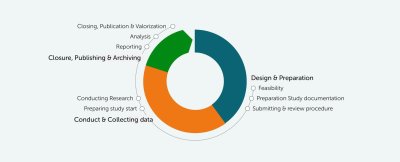
Use the different pages of the Research Roadmap to determine which steps are required in which phase of the study, and which support and services are available at Amsterdam UMC.