

What it takes to build an academic career: Six lessions from Febe van Maldegem
Lees dit artikel in het Nederlands
“Don't wait for opportunities to come your way. Shape your own path"
- Febe van Maldegem on taking ownership of your academic career.
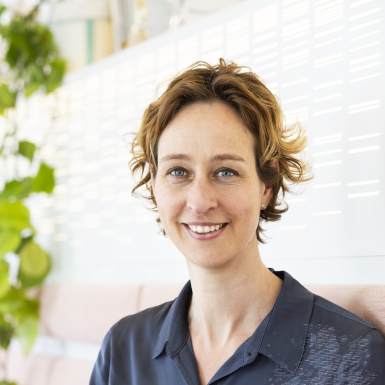
An academic career requires tough choices, a distinctive profile, and people around you who help you move forward. This is evident from the story of Febe van Maldegem, Associate Professor in the Department of Molecular Cell Biology and Immunology at Amsterdam UMC, who wants to make a difference for patients through her relevant field of scientific research.
After completing her doctoral research at the AMC, Febe moved to Cambridge on a Rubicon fellowship for her first postdoc. In terms of content, that project turned out not to be the direction she wanted to pursue, so she deliberately chose a second postdoc in London, again in cancer research. It was there that she developed the technology and expertise that now form the core of her profile: multiplex imaging of tumors (imaging mass cytometry), in which the tumor microenvironment is analyzed in detail using dozens of markers simultaneously.
Finding a distinctive niche in cancer research
Armed with this unique combination of tumor immunology and advanced image analysis, she set out to “enter the market”. She specifically sought out departments that were both interested in the subject matter and willing to invest in the technology. Amsterdam UMC purchased the equipment, and Febe brought her experience—that became her “selling point” and the basis for the Amsterdam UMC fellowship and, subsequently, a UHD position.
Balancing research, teaching and career expectations
In her current position, she combines leading a research group with extensive teaching responsibilities, including serving as the minor coordinator for medicine. This places a heavy burden on her, especially from September through Christmas: a lot of teaching, coordination, and administration on top of ongoing research, supervising her research group, and writing new research proposals on top of that.
She clearly feels that her heart lies in research, and that teaching—particularly the organizational aspects—is more of an obligation than a source of energy. One of her hopes for the future is that more colleagues with a specific teaching profile will be able to develop within the department so that everyone can focus on what they excel at. This hope aligns perfectly with the ambitions of the national program “Recognition & Rewards” which is embraced by Amsterdam UMC.
At the same time, she recognizes that the combination of research and teaching has accelerated her professional growth: through the fellowship, major grants, mentoring students and Ph.D. candidates, and taking on visible teaching roles, she was able to successfully complete her tenure track after just four years. However, she does note that the pressure of “building a portfolio” is high: constantly thinking about and working on BKO, leadership development, awards, and committee work.
Turning a broad network into a strength
Her research style places a strong emphasis on collaboration. She participates in international consortia and has numerous joint research projects with other groups both in the Netherlands and abroad. Initially, it was thought that this would make her far too unfocused to establish a clear line of research of her own, but because she was able to describe all of this in her portfolio and demonstrate the connections between the projects—thereby explaining the overarching themes—it was ultimately viewed positively. Her diversity and generalist approach were thus recognized after all.
Six tips for early-career researchers
Febe offers six concrete tips for early-career researchers:
1. Invest in distinctive expertise
Her second postdoc made all the difference: there, she learned technology that was barely available in the Netherlands at the time. A clear, unique skill set—in technology, methodology, or content—goes a long way toward securing your own position. So don’t just choose “any postdoc,” but one that sharpens your profile.
2. Actively seek out the right place
Febe looked for departments where her expertise was a good fit and where people were willing to invest in the relevant technology. That wasn’t a coincidence, but a deliberate strategy. For those just starting out: look beyond a single group or institution, and explicitly ask about the plans and resources related to your field.
3. Secure a strong mentor within the organization
She emphasizes how important it is that your Head of Department truly supports your career. Without that support, she says, you can perform as well as you want, but your profile won’t take off. Therefore, ask not only for guidance on the subject matter, but also for explicit support with career moves, applications, and visibility.
4. Use external coaching and courses for reflection
During her tenure track, Febe had an external mentor in addition to her department head and participated in programs such as a leadership course and the “Female Talent Program”. These helped her take a step back to look at herself and her career objectively and make strategic choices. For those just starting out: set aside time for this kind of reflection—it prevents you from simply “doing whatever comes your way”.
5. Build a broad network and don’t be afraid to collaborate
Collaborations provide access to materials, data, techniques, and new ideas—and are valued in evaluations. Febe consciously works with many different people and sees her network as an essential part of her success.
6. Be honest about what energizes you
High pressure is part of a tenure track, but for the long term, it’s important to recognize what you enjoy (in her case: research and substantive teaching, not administration and committees). Use that insight to prioritize tasks and, where possible, delegate them.
Shaping your own academic path
Through a combination of deliberate choices, distinctive expertise, and a strong support structure, Febe has quickly established a solid position. She looks forward to further building on that in the coming years. Her message to early-career researchers: don’t wait for opportunities to come your way, but shape your own path—and actively seek out the people and environment that will help you along the way, and that recognize and value your efforts.